Jamming together: Recreating improvised seventeenth-century musical divisions

We are delighted to host this guest post from Nina Kümin, a PhD candidate in music performance and baroque improvisation at the University of York.

The pleasure of your company is requested for a seventeenth-century jam session!

One of the main forms of music making for English middling society in the seventeenth century was consort music. Small groups of families, friends or neighbours would gather to play music together in several parts. While at the beginning of the seventeenth century, viols were the most popular instrument for this, as the century progressed the violin also grew in popularity. Of this music making, one of the most elusive traditions was that of playing “divisions”. This was the practice of adding florid ornamentation to printed music and improvising variations (making them up on the spot) taking inspiration from a popular printed theme. At the middle of the century, Playford, a publisher based in London and member of the Stationers’ Company, turned to printing collections of such example “divisions” on famous tunes which is testament to the tradition’s existence and growing popularity. His attempt to materialise an essentially immaterial art represents an increased demand from the growing amateur market; the divisions he provides are teaching materials, once accustomed to the art and with some general technical ability, Playford encourages the players to improvise their own. Through improvisation, the players moved from recreating works to being the creators, in control of the emotional development of the piece, the technical difficulty and the length. These published divisions, therefore, acted as an intermediary, temporary material form. Thanks to Playford’s publications, including Christopher Simpson’s The Division Viol of 1659 and Playford’s own The Division Violin of 1685, and through practice-led research, we can begin to reconstruct what it might have sounded and felt like to play or hear improvised divisions in the early to mid-seventeenth century, making the journey from immaterial sound and oral tradition through Playford’s material representations to the immaterial nature of improvisation again.

Each theme in Playford’s division manuals is set to a bassline which repeats all the way through called a “ground bass”. Let’s take “Faronell’s Divisions on a Ground” from Playford’s Division Violin as an example:

To the improvising musician, the bassline reveals which chords occur at which time. This ultimately reduces the number of possible notes an improviser can choose from as each chord change must be accompanied by a consonant (right sounding) note at first. The task of the improviser is then to find an interesting way to get between each of these important consonant notes.  The theory of consonance and dissonance was widely discussed in composition treatises at the time (English examples include Morely 1597; Mace 1676 and Matteis 1682) and is evident in many compositions over ground basses such as passacaglias as well as all of the examples in the Division Viol, Division Violin and Division Flute (a later collection by John Walsh from 1706). For this particular set of divisions, the harmony is as follows: Dm, A, Dm, C, F, C, Dm, A, Dm, A, Dm, C, F, C, Dm A, D. To the improviser, this means that you can chose one of the follow notes to start each chord:

Dm:      D, F, A

A:         A, C#, E

C:         C, E, G

F:         F, A, C

These, however, can be anywhere on the instrument and thus there are many possibilities even if there are only three named notes available for each chord. The materiality of the instrument, therefore, comes into play here too. As the violin, for instance, has four strings, only a maximum of four notes can ever be played together at any one time. In addition, the player has to be able to technically execute their ideas. It is therefore not realistic to pick notes which are at the extremes of the violin to jump between repeatedly; music tends to move by step or in smaller jumps. This reflects the vocal tradition in which singers also find large leaps difficult. Other considerations include the timbre (sound qualities) achievable. The lack of a shoulder and chin rest on the baroque violin also makes shifting, which facilitates the comfortable execution of large leaps, difficult. For each instrument, different strings will have different timbres due to the make of the violin and the material and winding of the strings but also the player’s technique and experience, not to mention the acoustic. This all also applies to viol playing and all of these factors might have a bearing on which of the options the improviser chooses. 

Finding interesting ways to get between these notes has its roots in ornamentation. This was common practice in all music of this time. This meant that musicians would not just play what was written on the material page but add their own little flourishes and touches between printed notes. These could include trills, scales, arpeggios, repeated notes, turns, chords, vibrato and mordents, just to name a few. For example, here is the theme from the same set of Playford variations played without any ornamentation and then with:


The results are really quite different. This illustrates the frustration of music publishers and composers in notating their works as all printed notation only materialises a small amount of the sounds heard (Kuijken, 2013). Interestingly, contemporary writers sought to rectify this by providing lengthy treatises on composition and performance which attempted to explain these practices (some English samples include Morely, 1597; Simpson, 1659; The Burwell Lute Tutor,1660; Mace, 1676 and Matteis, 1682). The musician, therefore, has an interesting relationship with the material form of the music in that this does not represent an absolute but rather a set of guidelines or suggestions; the musician was free to follow the score or deviate from it as they saw fit. Of course, this opportunity still exists today but current common musical practice does not allow any creative licence in the form of added notes unlike the conventions of the Baroque. By reading these treatises and experimenting on period instruments, performers can attempt to ornament in a stylistic manner.

Adding to these structural harmony notes and ornamentation, each variation in the division publications is in a different character. These have their roots in the “affects” (emotions) and dances. Certain keys and intervals were viewed as evoking certain affects. While the key for divisions is already established through the ground bass, players can experiment with different intervals to create different emotional effects. In addition, English music took inspiration from the French tradition of Baroque dance using their forms and rhythmic characteristics. This use is evident in notated compositions but also in the dance melodies in Playford’s The Dancing Master (1651). For instance, this set of Playford variations is actually based on a sarabande; the opening theme contains the characteristic crotchet + dotted crotchet + quaver rhythm and is in triple time. It can actually be danced to as I demonstrate here…

Middling musicians would also have been familiar with the different dance styles and characteristics not just from playing music based on dances but also through learning to dance themselves. The rhythms and playing styles associated with each dance style aid the dancer by stimulating lift, poise, energy or impetus, all of which these musicians would have been accustomed to and internalised through the physicality of dancing. Many of Playford’s variations use these to add variety and interest as the harmony remains the same throughout. It is therefore highly likely that improvised divisions would also have included dance inspired variations. There were opportunities to escape the repeating harmony in other musical forms such as the fantasia but a characteristic of the division practice was this repeating “ground bass” so variety and interest came from creating these different characters. 

Combining research into the intermediary material printed examples by Playford along with the advice in other treatises and the study of notated compositions in Playford’s The Dancing Master and those by his contemporaries, a set of guidelines can be produced for the modern performer seeking to improvise their own stylistic divisions:

  1. Begin each chord change with a consonant note, then find interesting ways to get between these structural notes
  2. Keep in mind the technical possibilities and characteristics of your instrument and performance space
  3. Create variety and interest through adding/ considering:
    1. Ornamentation
    1. Intervals to create different affects
    1. Dance rhythms and characters

Through practicing and experimenting in this manner, it is possible to improvise some stylistic variations. Therefore, I would now like to invite you to a virtual seventeenth-century jam session by encouraging you to pick and mix from the following variations, choosing however many you like and in whatever order you like, each video plays one example improvised variation. By playing them after each other you can build your own set of improvised divisions and therefore experience the improviser’s task of making decisions between key structural points. In this way, you can orchestrate your own structure and each time will give you a different result. This in some way mimics the excitement and variety of improvisation; they would never have played the same variation twice and were in control of the development and length of the piece. These variations were taken from a longer recording of my continuous improvised divisions over the ground bass of this same Playford piece. If you would like to hear them in their original order, this is also provided below.

Playford’s attempt to materialise the immaterial tradition of improvised divisions through his published examples, whether for viol or violin, not only recognised the existence of this tradition but allowed for a greater engagement with this by amateurs, a large number of which were middling recreational musicians, transforming their domestic cultural engagements. Musical improvisation is also deeply rooted in the material, however, as the performer’s relationship with their instrument determines a large proportion of the compositional decisions as well as the limitations of the technicalities of the instrument. The variety, creativity and individuality performed by these middling musicians would have been exciting to experience but Playford’s materialisations allow modern performers to also experiment with this practice.

Nina Kümin

Nina Kümin – Improvising Violinist – YouTube

The Elizabethan Civil Service, or If at First You Don’t Succeed, Get Up and Petition Again

British bureaucracy is under constant scrutiny, from the public, the press, and even the government itself. Yet administrative paperwork and systems of protocol have a long history that underpins the growth of the modern capitalist economy and the communities who sustained it. The individuals who drove the bureaucratic revolution in the sixteenth and seventeenth centuries, which witnessed the significant growth of English towns, were not monarchs or famous statesmen but literate middling men who possessed the necessary skills and networks to facilitate it.

Of particular importance were civic clerks. These individuals were responsible for writing out and filing legal documents and recording the minutes of civic assemblies. Whilst the professional role of town clerk is well recorded and the individuals traceable, the lives of under-clerks are often obscure. Although their work is preserved in myriad town documents, there is often little trace of the man behind the hand. Chester’s Hugh Dod was one such clerk for whom information can be found, and as such provides an interesting case study of the life of a professional scribe and lower civic official.

Dod is traceable through a series of petitions he entered throughout his lifetime to the civic authority of Chester in pursuit of a position in one of the city’s legal courts. As the Power of Petitioning Project has shown, although early modern petitions could take a variety of forms, in essence they were handwritten documents from an individual or group to a particular authority, requesting that a specific action be granted or carried out. In short, they were a means for inferiors to appeal to superiors, seeking a positive change to their present circumstances. Petitions were usually written up by a scrivener or scribe, so as a clerk Dod would have been familiar with the form and structure of a petition. Additionally, as he worked in civic government himself, he would also have known how to get a petition heard at the assembly. Only two of Dod’s original petitions survive but accounts of the others are found in the city’s assembly books, which record the minutes of meetings of the civic officials of Chester.

The surviving petitions are written out formally and addressed to the mayor, recorder, justices of the peace, aldermen, sheriffs, sheriff peers, and common council of Chester. The language used by Dod is deferential, ‘earnestlie desiringe’ preferment and the ‘favourable consente and allowances’ of the assembly. To further his case for preferment, he emphasizes certain ‘losses’ he has sustained in ‘labouringe meanes’ to obtain letters from his friends and patrons who wrote in support of his petition, demonstrating an impressive network of influential associates. However, networks and technical skill do not guarantee that a petition will be successful. Despite being literate, skilled, and well connected, Dod’s life was characterized by precarity. His position as a clerk clearly did not afford him the lifestyle he sought and as a result he was constantly petitioning for higher, and more permanent, employment.

Cheshire Archives and Local Studies: ZML/6/57, Petition of Hugh Dod, 1611, records in the Cheshire Record Office are reproduced with the permission of Cheshire Archives & Local Studies and the owner/depositor to whom copyright is reserved.

Dod first appears in the civic records in 1592, when his petition to be an attorney in the courts of Portmote and Pentice in Chester was considered by the assembly and deferred. The petition was either not considered again or rejected, as Dod put in another petition in 1594 to be an attorney in the same courts, which was also rejected. Dod then waited 12 years before entering another petition in 1606, in which he is described as a scrivener and petitioned the city to be made an attorney in the court of records. The petition reveals that Dod had previously served as an under-clerk in the Pentice, which was the town hall and court room in Chester for the local courts, and was looking to sidestep into another career, one in which he had no formal training. Instead, he claimed to have been ‘broughte upp under mr Knight late Clarke of the Pentice’ and ‘experimented in the premisses’. Dod had served under William Knight, who was Clerk of the Pentice from 1569 to 1600, for 17 years presumably at the end of Knight’s life, which would date his service to 1583-1600. Dod appears not to have had any prior legal training or education at a university of Inn of Court; he probably had a grammar school education. However, his training or experience as a scrivener meant that he would have been familiar with a range of legal documents. Nonetheless this informal legal apprenticeship did not satisfy the assembly and Dod’s petition was denied.

Five years later Dod petitioned the city once again. The petition from 1611 survives in the Chester archives. In it Dod claims that he had ‘the experience of a Scrivernor within the said Citie’ for the past 18 years and had throughout this period been ‘wanting sufficient preferment whereby to mentaine him selfe and his femely’. According to a manuscript written by Dod himself, clerks in Chester received a set fee of 8 pence per page for drawing up and entering of every sheet containing 14 lines in the court of Pentice and Portmote where Dod worked as an under-clerk. Professional scribes like Dod regularly earnt money outside of the courts writing up documents for private individuals, who lacked either the literacy or skill to draw up documents themselves. Indeed, Dod appears as a notary on various wills, indentures, and assignments in Chester in the period 1600-1640. However, Dod clearly believed that his earnings were not enough and requested a greater and more steady wage as an attorney in the common law courts of Chester.

For his 1611 petition, Dod did not just rely on his own protestations of experience but provided letters of recommendation from Sir Rogert Aston, Sir John Salusbury, and Thomas Ireland, who all presented their ‘harty commendacions’ to the mayor on behalf of Dod. All three men were well connected lawyers and courtiers. Aston was a courtier and Master of the Great Wardrobe to King James I, Salusbury was Esquire of the Body (a personal attendant) to Elizabeth I and a lawyer, and Thomas Ireland was a lawyer who later became the vice chamberlain of the Exchequer court of Chester. The exact relationship Dod had with these three individuals is difficult to ascertain. The letters from Salusbury and Ireland are quite standard letters of recommendation and include no specific information about Dod himself. The letter by Aston, however, further recounted Dod’s qualifications stating that he had been clerk under Knight and had ‘dwelled in the saide Citty’ ever since, suggesting that Dod did not hail from Chester originally. Dod had, Aston claimed, behaved himself ‘verie honestly’ in his role as a scrivener and ‘in respecte of his saide longe tyme of service’ was able ‘to discharge the duty of an attorney at the Comon Lawe’. Aston therefore desired the city to place him as such ‘the better to maineteyne himself when hee shall growe into further yeares’. Despite the letters Dod’s petition was again thought ‘not fit to be graunted’ and ‘utterly denied unto him.’

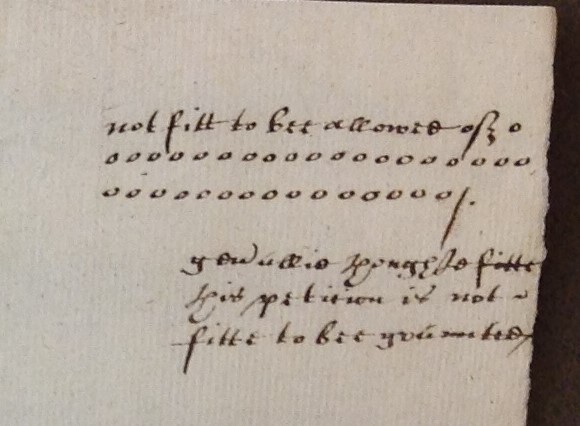
The votes of the assembly have been jotted down by another hand at the side of his petition on the same page and show that only 1 person voted in favour of the petition against 35 rejections. The decision by the assembly appears to have rested solely on Dod’s education. However, as Christopher Brooks has shown, to be an attorney did not require formal legal training at the Inns of Court but was more commonly learnt through apprenticeship. Either the assembly’s rejection of Dod was due to the fact he had not served his ‘apprenticeship’ under an attorney, or their decision rested on a personal issue not recorded in the assembly book.

Detail of CALS: ZML/6/57

A man of habit, Hugh Dod waited another five years before petitioning the city again in 1616. This time Dod played his trump card. He produced a letter from King James himself recommending his ‘welbeloved Subject Hughe Dod’ to an office in the courts of Chester due to the ‘acceptable service’ Dod had carried out ‘in writeinge of sundrie Instructions for the Ayde due for our deereste daughter the Lady Elizabeth’. In a further letter to the mayor Dod stated that his letter from the king proved that he ‘deserveth to be admitted’ to a position in the courts or, if he ‘happen to survive’ the incumbent William Hockenhull, to have the office of Serjeant in reversion. Despite Dod having friends in high places, his petition was once again refused, and he remained in his position as an under-clerk in the Pentice.

Dod’s situation may have improved slightly in 1627 when the current Clerk of the Pentice, Robert Brerewood, was suspended from office for negligence. It was thereby ordered, on 20 February 1627, that mayor Nicholas Ince ‘put in some fitting clerke or clerkes to execute the said place and office’ whilst Brerewood was suspended and to ‘take into his Custodye the Bookes and records of the said Office and of the Severall courts within the said Citty’. The name of the chosen individual is not recorded in the assembly book, but a manuscript written by Hugh Dod reveals that it was he who was appointed. In an account of the freemen admitted in Chester in the year 1626/7 Dod recorded that he ‘was admitted by the said Nicholas Ince in the tyme of his maioralty to write in the office of Pentice during the sequestracion thereof’. Despite his lack of formal training and prior rejections of legal office, the city was clearly happy to let Dod take on this significant role, albeit not as a permanent appointment. Clerks of the Pentice were not required to have formal legal training, although the two of the previous incumbents, Robert Whitby and Robert Brerewood, were both Inns of Court men, and the post had been filled previously by William Knight, Dod’s own patron, and Thomas Whitby who had both served apprenticeships. Therefore, Dod’s experience and training meant he had the experience needed to take up the role of temporary Clerk of the Pentice but did not possess the skills necessary for a more permanent office as an attorney.

After 11 months of sequestration a new Clerk of the Pentice, Richard Littler, was appointed and Dod was once again seeking employment. He petitioned the city one final time in 1631, requesting that in light of his service to the city, which included him writing up an official list of legal fees for the city, he deserved to be admitted to a legal office. Dod was never granted an office as an attorney and next appears in the civic records in 1636 when he petitions for an almsroom – charitable accommodation for the poor – in Chester, which had recently become available and was being allocated via ‘lott or ballettinge’. Ironically, this was Dod’s only successful petition. Dod retained the room until his death in 1639.

Dod’s petitions offer an insight into the life and career of an early modern civic clerk, a position that required literacy and a specific skill set that could be acquired through a form of apprenticeship. However, similar to being self-employed or working freelance today, Dod’s work as a clerk and professional scribe also required a certain amount of self-promotion and trading on his reputation to attract business. As such, his earnings were not set or secure and he clearly did not earn enough to support himself or his family. His skills were constantly deemed ‘not fit’ by the civic council to sidestep into the career of an attorney despite his experience and letters of recommendation. This suggests that whilst education, literacy, and patronage were important for social mobility, the exact set of skills acquired and how they had been obtained also mattered. As a result, Dod’s life was characterized by petitioning and precarity, and his social mobility and career progression were hampered by his lack of specialised education.

Mabel Winter

Sources

BL: Harl MS 1944, f. 115

BL: Harl MS 2020 and 2082: A catalogue of the Harleian manuscripts, in the British Museum. With indexes of persons, places, and matters : Free Download, Borrow, and Streaming : Internet Archive

CALS: ZAB/1, Assembly Book,

CALS: ZAB/2, Assembly Book,

CALS: ZM/AB/1, Apprenticeship Registers, f.27

CALS: ZML/6/57, Petition of Hugh Dod, 1611

CALS: ZML/6/58, Letter of Roger Aston, 1610

CALS: ZML/6/59, Letter of Thomas Ireland and John Salisbury

CALS: ZML/6/108, Letter from the King, 1616

CALS: ZML/6/112, Letter from Hugh Dod to Mayor Thomas Thropp, 1616

CALS: ZA/F/11/43, Petition of Hugh Dod, 1620

J. H. E. Bennett, The Rolls of the Freemen of the City of Chester, Part 1, 1392-1700, The Record Society for the Publication of Original Documents Relating to Lancashire and Cheshire Vol. 51 (1906)

Christopher Brooks, ‘Professions, Ideology and the Middling Sort in the Late Sixteenth and Early Seventeenth Centuries’, in Jonathan Barry and Christopher Brooks (eds) The Middling Sort of People: Culture, Society and Politics in England, 1550-1800 (Basingstoke, 1994)

Famarez Dabhoiwala, ‘Writing Petitions in Early Modern England’, in Michael J. Braddick and Joanna Innes (eds), Suffering and Happiness in England 1550-1850: Narratives and Representations: A collection to honour Paul Slack (2017)

Robert Tittler, Architecture and Power: The Town Hall and the English Urban Community c.1500-1640 (Oxford, 1991)

Keith Wrightson, Ralph Tailor’s Summer: A Scrivener, his City and the Plague (New Haven, 2011)

Power of Petitioning, The Power of Petitioning in Seventeenth-Century England (history.ac.uk)

Blog Post: Petitions in Early Modern England: A Very Short Introduction – The Power of Petitioning in Seventeenth-Century England (history.ac.uk)

History of Parliament, SALUSBURY, Sir John (c.1565-1612), of Lleweni, Denb. | History of Parliament Online

History of Parliament, IRELAND, Thomas (1560-1625), of Bewsey Hall, Warrington, Lancs and Gray’s Inn, London | History of Parliament Online

History of Parliament, ASTON, Sir Roger (-d.1612), of Edinburgh and Cranfold, Mdx. | History of Parliament Online