
Guest post by Hannah Yip, a Research Assistant for ‘GEMMS – Gateway to Early Modern Manuscript Sermons’, an SSHRC-funded project based at the University of Regina, Canada. Her latest article, ‘What was a Homily in Post-Reformation England?’, is published in The Journal of Ecclesiastical History.
The English Protestant divines discussed in this blog were of ‘professional middling’ status. Although they were highly educated individuals, many of them holding degrees from the Universities of Oxford and Cambridge, they relied on their livings and patronage from institutions and wealthier individuals to support themselves. While the role of published writings as instruments of patronage for Protestant clergymen in early modern England is widely recognised,[1] the question of whether there were alternative avenues for securing patronage, such as scribal publication, remains largely unaddressed. Moreover, how did Protestant preachers decorate their manuscripts intended for patrons? What evidence do we have that they practised the art of penmanship and drawing in their leisure time?
Today, the subject of ‘Protestant art’ in post-Reformation England constitutes a thriving area of study. Over the past thirty-five years, historians have continued to challenge Patrick Collinson’s ‘iconophobia’ thesis, contributing to a deeper understanding of the manner in which English Protestants generated a visual culture of their own.[2] While such research has included the Protestant clergy’s defence of visual imagery in certain contexts, there has been insufficient research into the practical engagement of these divines with the visual arts. One principal exception is represented in studies of the graphic art of Samuel Ward (1577–1640), town preacher of Ipswich; in particular, his print entitled The Double Deliverance, claimed by the minister to illustrate ‘the two grand blessings of God to this nation’ but ultimately misinterpreted as a personal affront to Catholic Spain.[3] The limnings of Stephan Batman (c. 1542–1584), rector of St Mary’s, Newington, Surrey, have also been explored at some length by M. B. Parkes, who has drawn attention to a treatise on the art of limning written by the cleric which appears to be no longer extant.[4] One of Batman’s commonplace books featuring his drawings survives as Houghton Library, Harvard University, MS Eng 1015, and is available to view in its entirety here.
To what extent did Protestant churchmen cultivate their skills in draughtsmanship, and why? This blog examines the devotional artistic endeavours of other Protestant ministers as manifested primarily in manuscript, posing crucial questions regarding their function as gifts for patrons or as forms of record-keeping and private meditation. It begins to enquire whether the pen-and-ink drawings within these manuscripts can be categorised as a genre of Protestant artwork which has not, thus far, been recognised either by palaeographers or by historians of early modern visual culture.
It was undoubtedly the case that the wide range of confessional allegiances, theological positions and religio-social groups could dictate Protestant divines’ appreciation for art and their own artistic pursuits. In their fascinating article about the scheme of imagery for a Wiltshire parish church designed by Christopher Wren (1589–1658), dean of Windsor and father of the famous architect, Louise Durning and Clare Tilbury emphasised the ways in which his designs negotiated the boundaries between the Laudian ‘beauty of holiness’ and a word-centred piety.[5] Jasper Mayne (1604–1672), a prolific poet and playwright as well as a Royalist Oxfordshire vicar, not only expressed his disdain for ‘the vanity of some of our Modern Prophets, who can see Idolatry in a Church-window’ in a typically moderate Protestant defence of ‘the Ornamentall use of Images’, but also revealed his dedication to art in a poem extolling the qualities of the ‘table-book’ of Anne King (b. c. 1621), sister of Bishop Henry King (1592–1669).[6] Detailed analysis into the attitudes of preachers hailing from multiple branches of Protestantism towards the visual and decorative arts richly merits further investigation.
Notwithstanding specific religious allegiances, it was certainly the case that an individual preacher’s skills in draughtsmanship could be used to his advantage when seeking or maintaining gentry patronage. With their bespoke woodcuts, engravings and accompanying verses, printed funeral sermons could serve as Protestant memorial keepsakes for a grieving patron’s family. Lucy Russell (c. 1581–1627), Countess of Bedford may have financed in part the production of a handsome octavo volume containing various visual and textual tributes to her brother, Sir John Harington, Second Baron Harington of Exton (c. 1592–1614).[7] A considerable number of presentation copies of manuscript sermons intended for patrons, written in the hand of the preachers themselves, survive in archives and libraries today. However, arguably few are as exquisite as a sermon dedicated to Lady Thomasine North of Mildenhall, Suffolk (c. 1586–1655), dated 27 August 1626 and preached locally by Nicholas Searle (1592–1678).[8] Searle was clearly an accomplished penman, exhibiting a variety of calligraphic hands in a manuscript which imitated a printed sermon in its layout and appearance, complete with decorated drop-cap initials. Bound in gold-tooled vellum, this was designed to pay tribute to an important patron in rural Suffolk.
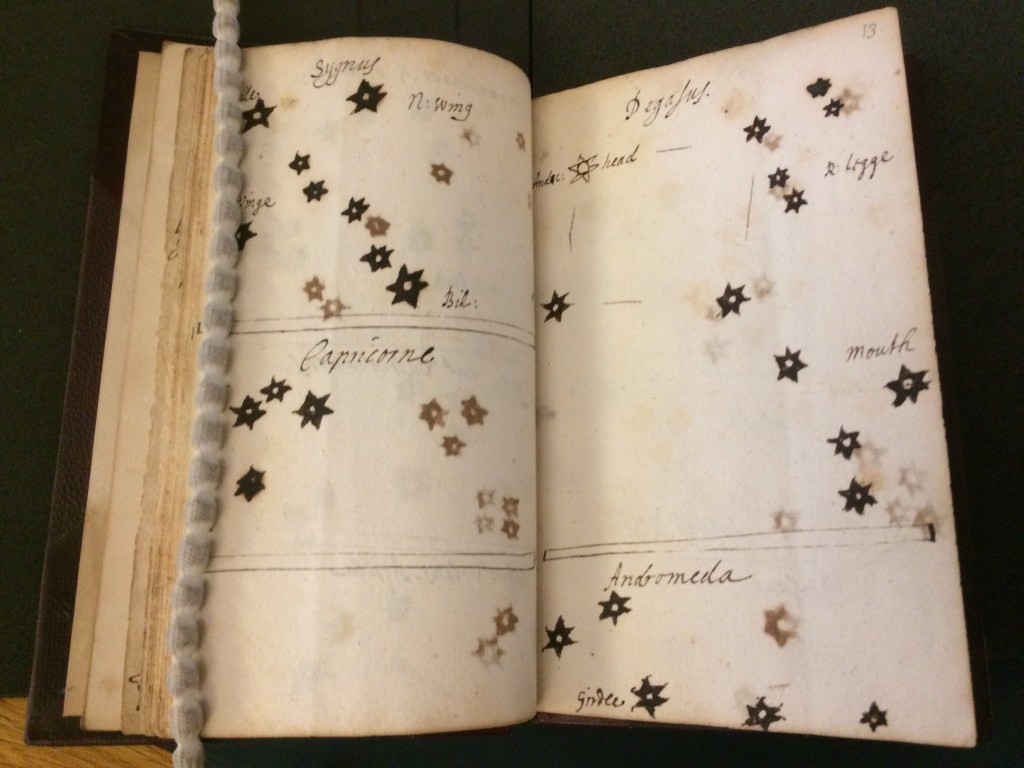
The drawings of divines could also be rendered at the service of record-keeping. The commonplace book of the Cambridgeshire vicar Edward Beaver (c. 1649–c. 1705), an octavo volume comprising notes of sermons which he had attended in addition to memoranda and accounts, also contains several diagrams which connect his interests in astronomy with his faith (see Figure 1). ‘The Constellations as they stand in ye North Hemespheer of Heaven’ are spread out over twelve pages (ff. 9v–15r). While clearly not as sophisticated as the efforts of his contemporary, the astronomer Reverend John Flamsteed (1646–1719), Beaver’s sketches reveal a personal engagement with scientific study. This was an aspect of a cleric’s interests which could often find its way into his sermons.[9] Choosing Revelation 2:1 as his text (‘Unto the angel of the church of Ephesus write; These things saith he that holdeth the seven stars in his right hand, who walketh in the midst of the seven golden candlesticks’), the royal chaplain Thomas Bradley (1599/1600–1673) muses upon whether the ‘seven stars’ refer to ‘that famous Constellation clearly visible in our Horizon, in dorso Tauri, called by Astronomers, the Pleyades’.[10] A yet more erudite marriage of astronomical knowledge with biblical exegesis appears throughout a sermon delivered by Robert Gell (1595–1665), rector of the affluent St Mary Aldermary, London. Preaching to the Society of Astrologers, Gell’s final exhortation argues that ‘a living and powerfull faith […] hath the vertues not onely of some one Star, or some one Asterisme, or Constellation, but even of all the Stars, all the Constellations of the heavens’. Citing Daniel 12:3 (‘And they that be wise shall shine as the brightness of the firmament; and they that turn many to righteousness as the stars for ever and ever’), Gell expresses his hopes that the members of his congregation ‘shall become true Magi’ who will subsequently ‘shine as the Firmament’.[11]
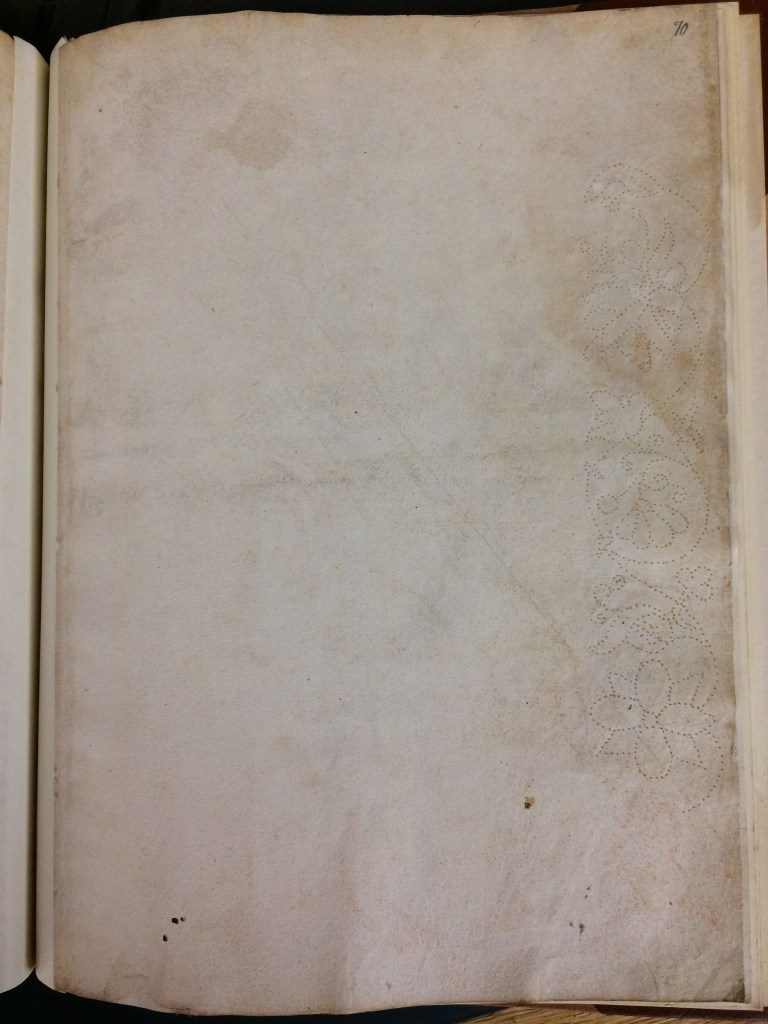
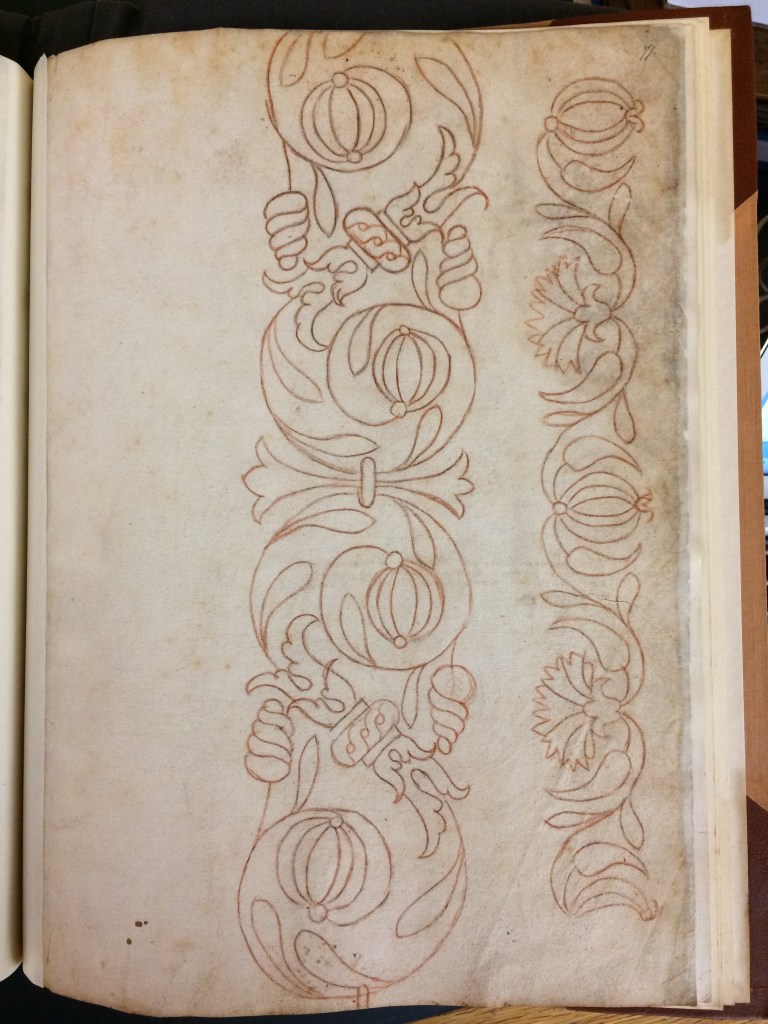
Finally, churchmen could also decorate their manuscripts ‘for art’s sake’. British Library, Harley MS 663 is an autograph folio volume containing notes relating to the private accounts and sermons of William Hull (d. 1626), lecturer at St Oswald’s Church, Ashbourne, Derbyshire and dating from the first quarter of the seventeenth century.[12] At the end of the volume, there are several decorative tracings and drawings in pencil, evidently pricked from an original printed source (see Figure 2). There is little evidence to suggest that the volume was owned by anybody other than Hull before it passed into the Harleian Library. It is therefore likely that, in a spare moment, Hull traced these designs for his own pleasure. Such practices would not have been lost on the likes of an even more illustrious churchman, Bishop John Cosin (1595–1672). As Adrian Green has shown, the designs for Cosin’s ecclesiastical woodwork were inspired by Netherlandish and German pattern books.[13]
Deriving from devotional pursuits, but also undertaken at their leisure, these diagrams, drawings and instances of ornamental penmanship blur the boundaries between ‘recreation’ and ‘work’ in the service of God. Whereas the art of drawing and calligraphy may have been considered as secular pursuits which were at odds with clerical vocation, it was the case that these talents could, in fact, be utilised at the service of patronage, or to ally external interests in natural phenomena with the Protestant faith.[14] This blog challenges older assertions that the practice of drawing and limning was the principal preserve of royalty, courtiers and the landed gentry in the seventeenth century.[15] Such assumptions mean that it is of no surprise that preacher-painters exist on the margins of art-historical research. For example, Robert Tittler’s invaluable ‘Early Modern British Painters’ resource does not mention Francis Potter (1594–1678), rector of Kilmington, Somerset, whose portrait of Sir Thomas Pope (c. 1507–1559) hangs in Trinity College, Oxford, which Pope founded (see Figure 3).[16] The painting is an accomplished work, showing Potter’s sensitivity to the intricacies of his sitter’s jewellery and ermine.

Very little research has been undertaken thus far on how preachers acquired these creative skills. By beginning to examine the artistic recreational activities of Protestant divines, this blog has highlighted that more research is required regarding the relative social status of the clergy, the ‘largest profession of the early modern period’, and the leisure time that they could afford to take.[17] Endowments attached to certain livings varied enormously, as did the backgrounds and early upbringings of clergymen.[18] It is possible that certain churchmen were able to build a rapport with the middling sorts ensconced within their parish by taking up recreations which they could identify with. Jill Francis has shown how the published garden designs of William Lawson (1553/4–1635), vicar of Ormesby in the North Riding of Yorkshire, were ‘simplified and accessible’, aimed towards the emerging class of rising gentry in the first quarter of the seventeenth century.[19] Considerations of space have precluded discussion of wealthier clergymen’s activities as art collectors, including the intriguing career of the Cumbrian rector William Petty (c. 1585–1639), who was both chaplain to Thomas Howard (1585–1646), Earl of Arundel and his principal agent, purchasing collections on his behalf.[20] Investigating the artistic recreations of clergymen in early modern England leads to the potential for discovering the origins of the characteristics of the Hanoverian squarson, whose lifestyle bore strong similarities to those of the landed gentry.[21] The recognition of certain preachers’ abilities to interpret art is also crucial for enhancing scholarly understanding of their engagement with the religio-political controversies of their day. In a published defence of a painting censured as showing King Charles I’s submission to the Pope, the Royalist divine Daniel Featley (1582–1645) demonstrated that the work was a representation of a story from the Golden Legend, analysing with considerable detail its religious symbolism which was incompatible with the accusations against the painting put forward at the Star Chamber.[22]
Moreover, whereas Durning and Tilbury previously argued that Dean Christopher Wren’s visual skill was ‘hardly a typical attribute of the early modern cleric’, this blog argues that, on the contrary, a wider awareness of certain clergymen’s capabilities as visual thinkers would advance scholarly knowledge of the external influences that informed the composition of their sermons.[23] The admirable work of Jean-Louis Quantin, Katrin Ettenhuber and Noam Reisner, amongst others, has revealed how preachers drew upon classical literature in addition to theological texts, ancient and modern.[24] But what about the godly inspiration which could be gained from studying artistic treatises? According to William A. Dyrness, The Mysteryes of Natvre and Art (London, 1634), a treatise by John Bate (fl. 1626–1635) which covered the art of drawing and painting, was owned by the staunchly godly Mather family in New England.[25] While I have argued elsewhere for the enthusiasm of the ‘hotter sort’ of Protestant ministers for other types of visual devices such as anagrams, more meticulous study may disclose further evidence of the appreciation of, and active engagement with, visual culture by clergymen across the wide spectrum of Protestant belief in post-Reformation England.[26]
Notes
[1] Paul Seaver, ‘Puritan Preachers and their Patrons’, in Religious Politics in Post-Reformation England: Essays in Honour of Nicholas Tyacke, ed. by Kenneth Fincham and Peter Lake (Woodbridge: The Boydell Press, 2006), pp. 128–42.
[2] Among a large literature, see, in particular, Tara Hamling and Jonathan Willis, ‘After Iconophobia? An Online Symposium’, <https://manyheadedmonster.wordpress.com/2017/03/20/after-iconophobia/> [accessed 12 November 2020].
[3] Alexandra Walsham, ‘Impolitic pictures: providence, history, and the iconography of Protestant nationhood in early Stuart England’, Studies in Church History, 33 (1997), 307–28; Helen Pierce, Unseemly Pictures: Graphic Satire and Politics in Early Modern England (New Haven, CT and London: Yale University Press, 2008), pp. 35–47; Ema Vyroubalová, ‘Catholic and Puritan Conspiracies in Samuel Ward’s The Double Deliverance (1621)’, in Puritans and Catholics in the Trans-Atlantic World 1600–1800, ed. by Crawford Gribben and Scott Spurlock (Basingstoke: Palgrave Macmillan, 2016), pp. 47–65.
[4] M. B. Parkes, ‘Stephan Batman’s Manuscripts’, in Medieval Heritage: Essays in Honour of Tadahiro Ikegami, ed. by Masahiko Kanno and others (Tokyo: Yushodo Press, 1997), pp. 125–56 (p. 128).
[5] Louise Durning and Clare Tilbury, ‘‘Looking unto Jesus’[:] Image and Belief in a Seventeenth-Century English Chancel’, Journal of Ecclesiastical History, 60.3 (2009), 490–513.
[6] Jasper Mayne, A late Printed Sermon Against False Prophets, &c. ([London], 1647), p. 15; British Library, Harley MS 6931, ff. 59r–60v.
[7] Richard Stock, The Chvrches Lamentation for the losse of the Godly, &c. (London, 1614); Ted-Larry Pebworth, ‘“Let Me Here Use That Freedome”: Subversive Representation in John Donne’s “Obsequies to the Lord Harington”’, The Journal of English and Germanic Philology, 91.1 (1992), 17–42 (p. 40).
[8] Suffolk Record Office, Ipswich, HD607/1. For presentation copies of sermons in manuscript which follow print conventions, see Mary Morrissey, ‘Sermon-Notes and Seventeenth-Century Manuscript Communities’, Huntington Library Quarterly, 80.2 (2017), 293–307 (p. 300).
[9] For Flamsteed, see Frances Willmoth, ‘Flamsteed, John (1646–1719)’, Oxford Dictionary of National Biography, online edn (2008), <https://doi.org/10.1093/ref:odnb/9669> [accessed 13 November 2020].
[10] Thomas Bradley, A Sermon Ad Clerum, &c. (York, 1663), p. 4.
[11] Robert Gell, Stella Nova, A New Starre, Leading wisemen unto Christ (London, 1649), pp. 30–1.
[12] For this manuscript, see Arnold Hunt, The Art of Hearing: English Preachers and Their Audiences, 1590–1640 (Cambridge: Cambridge University Press, 2010), pp. 276–81.
[13] Adrian Green, Building for England: John Cosin’s Architecture in Renaissance Durham and Cambridge (Durham: Durham University, 2016), p. 16.
[14] Mordechai Feingold, ‘Parallel Lives: The Mathematical Careers of John Pell and John Wallis’, Huntington Library Quarterly, 69.3 (2006), 451–68 (p. 457).
[15] Kim Sloan, ‘A Noble Art’: Amateur Artists and Drawing Masters c. 1600–1800 (London: British Museum, 2000), p. 11.
[16] Robert Tittler, ‘Early Modern British Painters, c. 1500–1640’ (September 2019), <https://spectrum.library.concordia.ca/980096/> [accessed 12 November 2020].
[17] Arthur Burns, Kenneth Fincham and Stephen Taylor, ‘Reconstructing Clerical Careers: The Experience of the Clergy of the Church of England Database’, Journal of Ecclesiastical History, 55.4 (2004), 726–37 (p. 737).
[18] Rosemary O’Day, ‘The Anatomy of a Profession: the Clergy of the Church of England’, in The Professions in Early Modern England, ed. by Wilfrid Prest (London: Croom Helm, 1987), pp. 25–63; Fiona McCall, ‘Children of Baal: Clergy Families and Their Memories of Sequestration during the English Civil War’, Huntington Library Quarterly, 76.4 (2013), 617–38 (p. 618).
[19] Jill Francis, ‘Order and Disorder in the Early Modern Garden, 1558–c. 1630’, Garden History, 36.1 (2008), 22–35 (pp. 29–30).
[20] For clergymen’s art collecting, see Tarnya Cooper, Citizen Portrait: Portrait Painting and the Urban Elite of Tudor and Jacobean England and Wales (New Haven, CT and London: Yale University Press, 2012), pp. 138, 153. For William Petty, see David Howarth, ‘Petty, Rev. William’, Grove Art Online, <https://doi.org/10.1093/gao/9781884446054.article.T066833> [accessed 13 November 2020].
[21] Wilfrid Prest, ‘Introduction: The Professions and Society in Early Modern England’, in The Professions in Early Modern England, ed. by Wilfrid Prest (London: Croom Helm, 1987), pp. 1–24 (p. 18).
[22] Daniel Featley, The Sea-Gull, &c. ([London], 1644); Laura Lunger Knoppers, Politicizing Domesticity from Henrietta Maria to Milton’s Eve (Cambridge: Cambridge University Press, 2011), pp. 38–40.
[23] Durning and Tilbury, ‘‘Looking unto Jesus’’, p. 513.
[24] Jean-Louis Quantin, The Church of England and Christian Antiquity: The Construction of a Confessional Identity in the 17th Century (Oxford: Oxford University Press, 2009), ch. 1; Katrin Ettenhuber, Donne’s Augustine: Renaissance Cultures of Interpretation (Oxford: Oxford University Press, 2011); Noam Reisner, ‘The Preacher and Profane Learning’, in The Oxford Handbook of the Early Modern Sermon, ed. by Peter McCullough, Hugh Adlington and Emma Rhatigan (Oxford: Oxford University Press, 2011), pp. 72–86.
[25] William A. Dyrness, Reformed Theology and Visual Culture: The Protestant Imagination from Calvin to Edwards (Cambridge: Cambridge University Press, 2004), pp. 223–24.
[26] Hannah Yip, ‘‘Speaking now to our eyes’: Visual Elements of the Printed Sermon in Early Modern England’ (unpublished doctoral thesis, University of Birmingham, 2020), ch. 3.

